

IT Outsourcing: what it is, how it works, and when it makes sense
Imagine your company needs to develop a new application, improve its sales platform, or add a new feature to its software. You know exactly what you want to achieve, you have the budget, and you've even set a launch date.
But there’s one problem you hadn’t anticipated: your IT team already has its hands full, and hiring new people could take months.
So, what do you do? Delay the project? Put even more pressure on your existing team? Start recruiting without knowing when you’ll find the right person? That’s where IT outsourcing comes in. It’s a way to bring technology professionals into your business without having to permanently expand your workforce.
And while you might think it’s something only large corporations use, the truth is that IT outsourcing can be useful for businesses of almost any size.
What is IT outsourcing?
IT outsourcing means working with external professionals or teams to handle specific technology-related tasks or projects.
For example, one company might need a specialist developer for six months. Another might need a QA team to test an application before launch. And another might need several IT professionals to support its technology department during a period of growth.
Would they really need to hire all these people directly? Not necessarily. They could bring them on board through a company specialising in IT outsourcing.
And that doesn’t necessarily mean handing over the entire project. Quite often, external professionals work alongside the company’s existing team, use the same tools, attend the same meetings, and work towards the same goals.
The main difference lies in how the professionals are contracted and how the service is managed.
How does IT outsourcing work in practice?
Every business has its own needs, but the process usually starts by identifying what needs to be done and which professionals are required to do it.
Let’s say an e-commerce company wants to improve its platform, but its developers are busy maintaining existing systems. It needs two additional specialists for the next eight months.
In this situation, an IT outsourcing provider could help the company find experienced professionals who can join the project and work alongside its existing team.
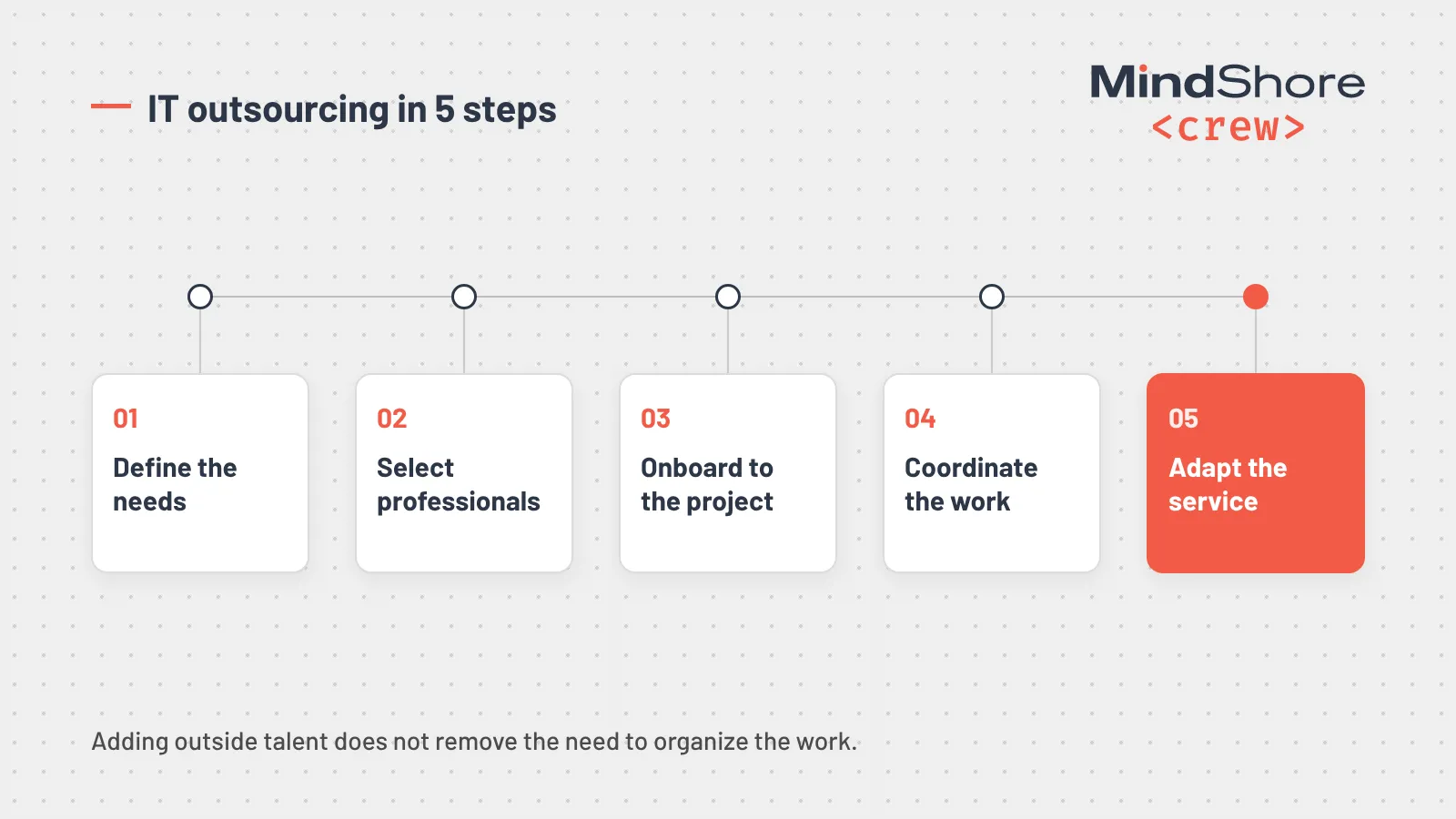
Typically, the process involves the following steps:
- Identifying the company’s needs. What roles are required? What skills should those professionals have? How long will they be needed? What responsibilities will they take on?
- Selecting the right professionals. Finding people who have the necessary technical skills and fit the team’s way of working.
- Bringing them into the project. Giving them access to the tools, documentation, and people they’ll be working with.
- Coordinating the work. Defining objectives, responsibilities, communication channels, and ways to monitor progress.
- Adapting the service. Increasing, reducing, or changing the professionals involved as project requirements evolve, depending on the agreed terms.
And there’s something important to remember: bringing in external professionals doesn’t remove the need for good organisation. If nobody knows who’s making the decisions, priorities keep changing every other day, or documentation is nowhere to be found, those problems aren’t going to disappear just because someone else is writing the code.
What are the benefits of IT outsourcing for businesses?
One of the main reasons companies turn to IT outsourcing is to access specialised professionals without always having to go through a traditional recruitment process. But there are several other benefits worth considering.
Access skills you don’t have in-house
Not every company needs a full-time cybersecurity specialist, software architect, or data engineer. However, it might need one during a migration, a systems integration, or a particular stage of a project.
IT outsourcing allows businesses to access that expertise when they actually need it.
Strengthen your team without overloading it
Sometimes, an IT department simply can’t take on any more work. Bringing in external professionals gives you the opportunity to share the workload, meet realistic deadlines, and avoid having the same people responsible for everything.
Adapt to your business needs
Some projects need five developers during their initial stages but only two once they move into maintenance. Having an external team to support you can make it much easier to adjust your resources at each stage, within the terms you’ve agreed.
Have greater control over costs
It’s true that outsourcing isn’t always cheaper than hiring your own employees. That depends on the skills you need, the number of professionals involved, the length of the engagement, and the contract terms.
But what outsourcing can offer is greater predictability over costs, while reducing some of the administrative work associated with recruitment and employment. And that’s without mentioning the time you can save finding and onboarding an entire team!
When does IT outsourcing make sense?
There’s no single answer that works for every company, but there are plenty of situations where this approach can be particularly useful.
- When you need to start a project but don’t have enough people available. Spending months trying to build a team could mean missing a business opportunity.
- When you need highly specialised skills. Particularly if you’re working with technology your company doesn’t normally use.
- When you’re dealing with peaks in workload. Product launches, migrations, new features, or projects with a defined timeframe.
- When you want to expand your IT capabilities without suddenly building a much larger department. This can be especially useful for growing businesses or companies that aren’t yet sure whether their increased workload will continue.
Of course, there are also situations where hiring someone directly makes more sense. For example, if you need someone for a long-term strategic position, with extensive knowledge of your business and industry, and ongoing responsibilities, bringing that person into your permanent team might be the better option.
But there’s no reason why both approaches can’t work perfectly well together.
What should you check before choosing an IT outsourcing provider?
Before choosing a provider, don’t focus solely on their hourly rates or the CVs of the professionals they offer.
There are a few other things worth considering:
- First, ask yourself how these professionals will fit into your existing team. Who will coordinate their work? How will absences and replacements be handled? And what happens if your project requirements change?
- It’s also essential to agree on matters such as confidentiality, information security, system access, and how the work will be documented.
- And here’s something particularly important: what happens to all the knowledge gained during the project once the collaboration ends? A good outsourcing service should help ensure that knowledge stays within your company rather than disappearing when the contract comes to an end.
Ultimately, IT outsourcing works best when it’s seen as more than simply paying someone by the hour. Because behind every software development project, integration, or testing process, there are people who need to work together, communicate, share information, and understand what the business is trying to achieve.
At MindShore Crew, that’s exactly how we see what we do: helping companies bring in technology professionals who work alongside their teams, contribute to their projects, and share their goals.
Because it’s not just about finding someone who knows how to write code, test an application, or manage IT infrastructure. It’s about finding the right people to get the job done.
Does your company need to strengthen its IT team? We can help you find the professionals you need and bring them into your projects.