

How to Build an AI Team: A Practical Guide
Building technology is hard, but it tends to be predictable. Building the team around it is where most AI efforts fall apart. A strong AI team starts with a clear business problem, begins with a handful of roles, and grows as the project demands. This guide covers how to get there and which mistakes to avoid.
AI raises the stakes. It brings new roles with unfamiliar responsibilities, inflated expectations, and plenty of confusion about what works in theory versus what works in production.
Start with the problem, not the technology
Before you think about models, data, or tooling, answer one basic question: what problem are we trying to solve? Detecting fraud, improving forecasts, automating processes, supporting a human team, or cutting response times all lead to different teams.
The costliest mistake is bringing in AI because everyone else is. An internal recommendation system is a different job from an AI product for end customers, and working with clean data is nothing like untangling years of historical mess.
Without a clear goal, you end up with talented people who are not sure what they are supposed to build.
Which roles does an AI team need first?
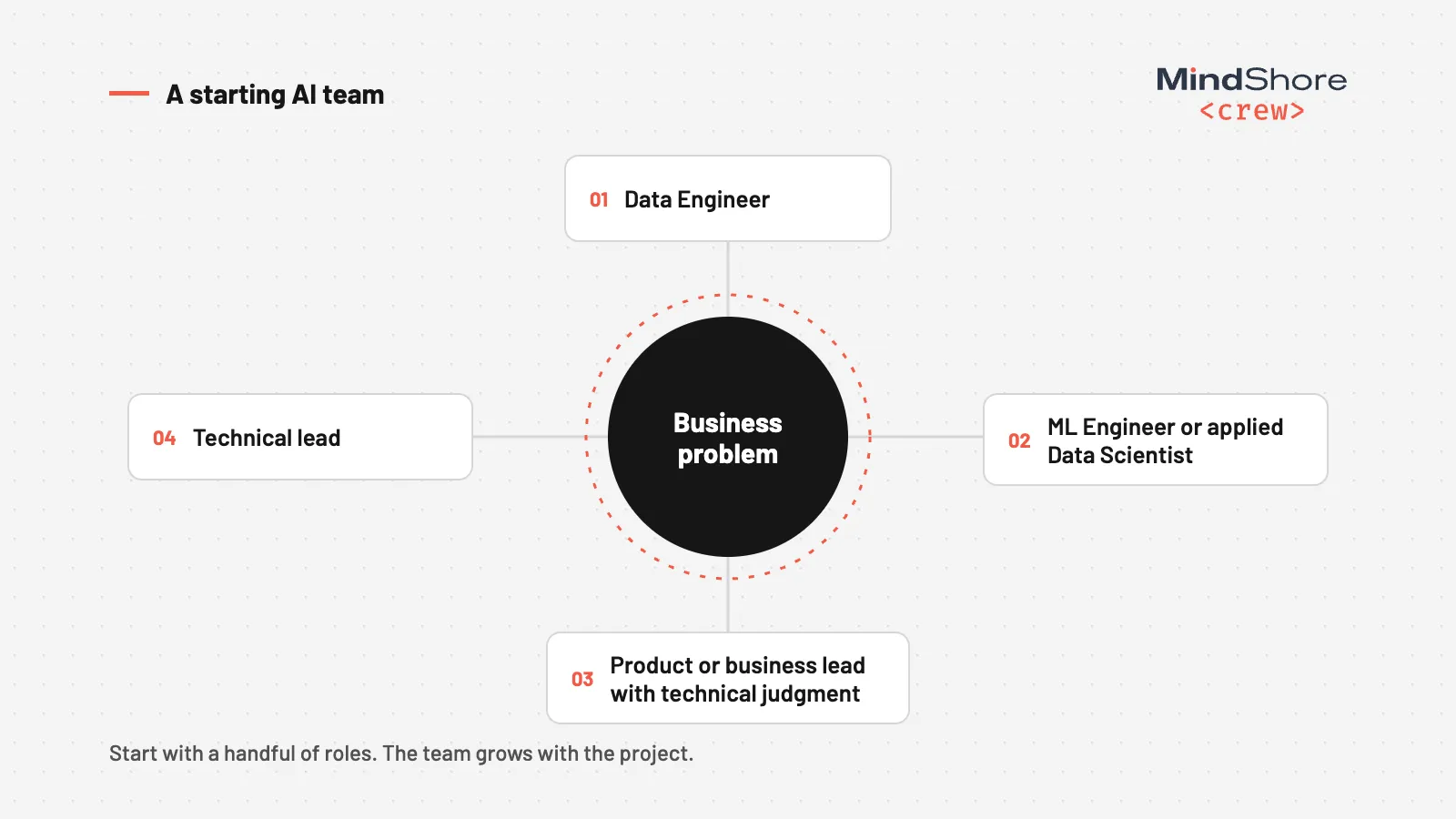
Not ten. Starting with too many profiles usually backfires. In the early stages, most teams need four:
- Data Engineer. Without clean, accessible data, AI goes nowhere. This role owns pipelines, data quality, and access to information.
- Machine Learning Engineer or applied Data Scientist. Fewer papers, more models in production. Someone who is comfortable experimenting and also knows how to deploy.
- Product or business lead with technical judgment. The translator between what the business wants and what is possible. This role usually comes from your own organization, since it is the person who knows the business best.
- Technical lead. Makes the calls, sets priorities, and shields the team from outside pressure.
As the project grows, the team grows with it. Starting oversized is frustrating and expensive.
How to get AI into production
This is where many projects quietly disappear: strong prototypes nobody uses, teams worn out by constant changes of direction, and models that run perfectly on a laptop and fail in production. A few rules help:
- Ship small increments that work instead of waiting for a perfect final release.
- Decide on day one how the system will be deployed, maintained, and scaled.
- Define metrics and real impact early: time saved, errors avoided, better decisions made.
- Keep constant contact with the business. A team that works in isolation loses the project, even when the engineering is flawless.
AI teams need to sit close to where decisions get made.
Culture and expectations: the part most teams underestimate
Technology matters a great deal, but team culture matters more. Four things are worth protecting:
- Realistic expectations. AI does not replace everything, and it rarely works perfectly on the first try.
- Room to test and fail. Without room for mistakes there is no innovation, as long as accountability and focus stay in place.
- Continuous learning. The field moves fast, so the team needs time to learn and share what it knows.
- Care for your people. These profiles are in high demand. Burn them out and they will leave for a competitor.
Common mistakes when building an AI team
- Hiring because a role sounds trendy.
- Copying the structure of large companies without their context.
- Promising leadership results that cannot be delivered.
Build an AI team calmly and with good judgment: understand the business, surround yourself with the right people, and create an environment where the technology makes sense. Get that right and AI stops being an experiment and becomes a real advantage.