

How to Foster Continuous Improvement in Engineering Teams
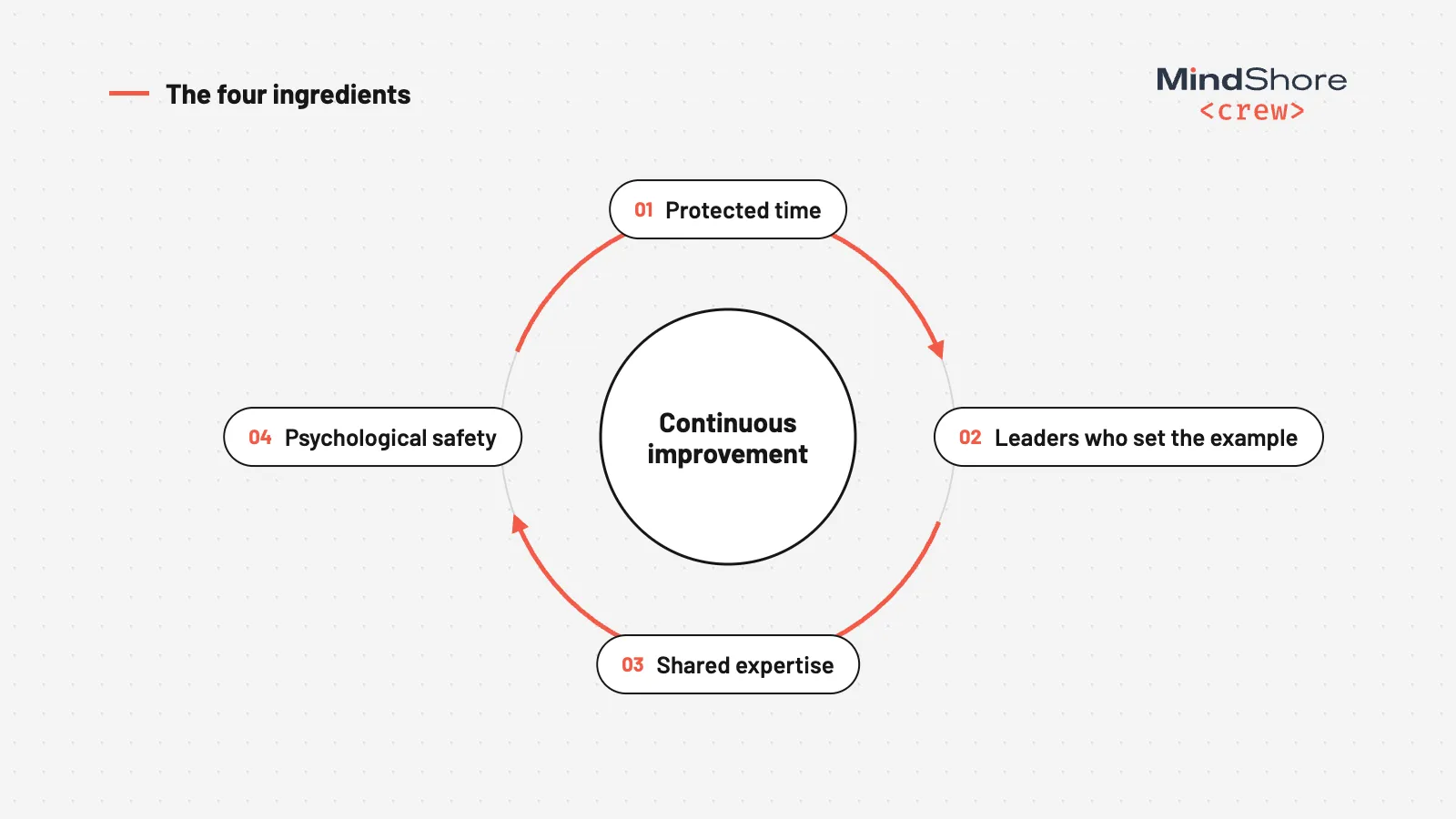
In engineering, learning comes with the territory. Technology races ahead, and groups that stop absorbing fresh expertise keep reaching for the same old solutions. Continuous improvement in an engineering department takes hold when study becomes part of the routine instead of an afterthought squeezed into free moments. It rests on four ingredients: protected time, leaders who set the example, shared expertise, and psychological safety.
Plenty of companies claim to value development, yet in practice they postpone it until “there is time,” and that moment rarely arrives. Deadlines, incidents, meetings, and fresh priorities always get there first. If an organization wants its technical people to grow, it must carve out a concrete space.
Learning cannot depend on spare time
A frequent misstep is treating training as a side issue, something for later, once the workload eases. Yet no group improves just by wanting to. It improves when it has room to review, experiment, share, and draw conclusions from its daily work.
Some of the best lessons also sit inside the project itself: a delivery that stalled, a technical choice that backfired, or an incident that forced a rethink of a process. At MindShore, we have seen that what people learn from real situations proves more useful and far easier to retain.
Leadership sets the pace for improvement
A learning culture is contagious. When those in charge share what they know, ask questions, admit doubts, and explain their choices, everyone else understands that growth is part of the assignment. When they correct without context, solve everything alone, or turn every slip into friction, the outcome is the reverse:
- Silence
- Dependency
- Fear of getting things wrong
In technical settings, example carries weight. A good manager does more than organize and oversee. A good manager shapes a climate where questioning ideas, asking for help, and revisiting decisions feel natural and safe.
Shared knowledge makes the team stronger
Many organizations lean too hard on a handful of people who master certain parts of the system better than anyone. While they are present, everything runs. Trouble starts when they are away, swamped, or reassigned to another initiative. The wider expertise spreads, the more autonomy the group enjoys and the fewer bottlenecks appear.
That calls for thorough documentation, explaining the reasoning behind decisions, easing collaboration, and treating teaching as part of the technical craft instead of a burden.
The strongest groups are not the ones where each individual knows the most. They are the ones that distribute their experience best.
Without psychological safety, there is no real improvement
Improving means trying, adjusting, reviewing, and trying again, which includes getting things wrong. In demanding work like engineering, almost nothing succeeds on the first attempt. The real trouble starts when every failure is felt as a threat: people stop proposing ideas, dodge risk, and cling to what they already know.
Benefiting from failure does not mean tolerating all of it without question. It means separating a reasonable misjudgment, which can teach something, from plain negligence. A group able to examine what went wrong without turning defensive advances faster and further.
In short, continuous improvement springs from a way of working where study has space, sharing has value, and setbacks do not paralyze anyone. When that happens, it shows in the quality of deliveries, in each person’s autonomy, and in the group’s ability to adapt to whatever comes next.